How to Perform a Skin Cancer Self-Exam: What Dermatologists Look For
Featuring Dr. Clare Goggins, a board-certified dermatologist providing expert medical care to both adult and pediatric patients.
You’ve noticed something on your skin that wasn’t there before. Or maybe there’s a mole that looks different than it used to. So you’re doing what most people do at 11 PM on a Tuesday: searching the internet, comparing what you’re seeing to images online, and quietly spiraling into worst-case scenarios.
If you’re here because you’re worried about skin cancer, let’s start with this: noticing changes in your skin and taking them seriously is exactly what you should be doing. Skin awareness isn’t paranoia—it’s smart healthcare.
Dr. Clare Goggins, a board-certified dermatologist at Aesthetic Dermatology Associates, sees patients every week who are anxious about skin changes they’ve discovered. Her approach combines Johns Hopkins-trained clinical expertise with something equally important: helping patients understand what they are actually looking at.
“The goal of self-examination isn’t to diagnose yourself,” Dr. Goggins explains. “It’s to become familiar enough with your own skin that you notice when something changes. That awareness—combined with regular professional screenings—is what catches skin cancer early, when it’s most treatable.”
Why Self-Exams Matter (But Can’t Replace Your Dermatologist)
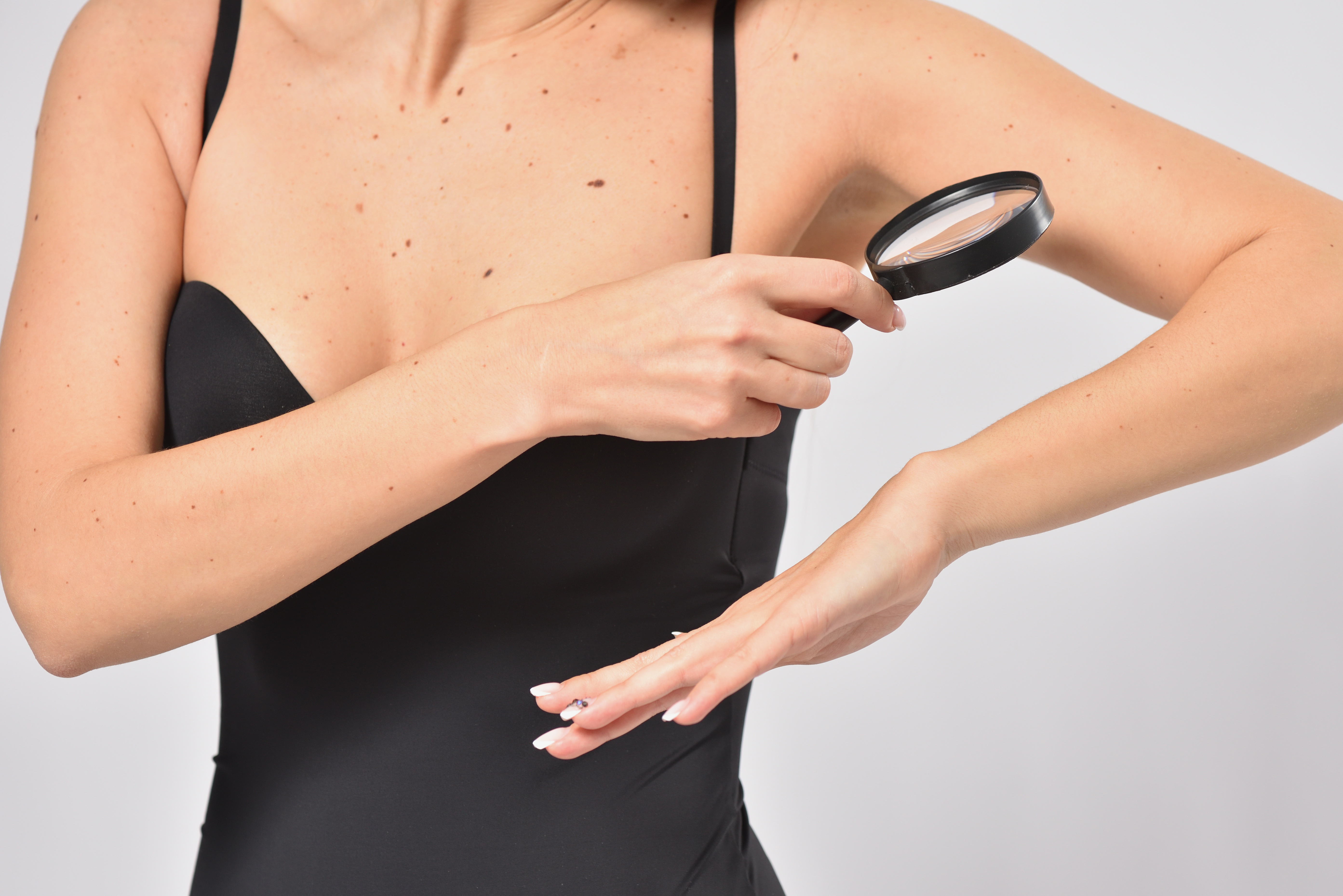
Here’s something that might surprise you: most skin cancers are first noticed by patients themselves, not by doctors during routine exams. You see your skin every single day. Your dermatologist sees it once, maybe twice, a year depending on your medical history.
But here’s the critical distinction: self-exams help you know when to see a doctor. They don’t tell you what something is or isn’t. That anxiety you’re feeling while comparing your mole to images online? That’s your cue to stop searching and schedule an appointment instead.
The ABCDE Method: What Dermatologists Look For
Dermatologists recommend a framework called the ABCDE method to identify suspicious moles and melanoma. This is the same clinical approach Dr. Goggins uses when examining patients.
Asymmetry: If you drew a line through the middle of the mole, would both halves look the same? Normal moles are typically symmetrical. Melanomas often aren’t.
Border irregularity: Normal moles have smooth, even edges. If the border is ragged, notched, blurred, or irregular, that’s worth noting.
Color variation: A normal mole is usually one uniform color. If you’re seeing multiple colors within the same spot (brown mixed with black, red, white, or blue), that’s a warning sign.
Diameter: Melanomas are often (though not always) larger than 6mm—about the size of a pencil eraser. But don’t discount something just because it’s small.
Evolving: This is the most important letter. Has the mole changed over the past few weeks or months? Is it getting bigger, darker, raised, or behaving differently? Change over time is the single biggest red flag.
Dr. Goggins adds an important caveat: “The ABCDE method is incredibly useful, but it’s not foolproof. That’s why the ‘ugly duckling’ sign matters too—if you have one mole that just looks different from all your other moles, even if it doesn’t check the ABCDE boxes, call your dermatologist to have it examined.”
How to Perform a Self-Exam (Step by Step)
You don’t need special equipment or medical training. You need decent lighting, two mirrors (a full-length mirror and a handheld one), and about 15 minutes of uninterrupted time. Do this once a month.
Start at your face and scalp. Examine your face, ears, neck, and scalp carefully. Use the handheld mirror to check areas you can’t see directly. If you have thick hair, use a blow dryer to part sections so you can see your scalp.
Move down your body systematically. Check your shoulders, chest, and torso—front and back. Look under your arms. Examine both sides of your arms, your hands, between your fingers, and under your nails.
Check areas that don’t see the sun. Look at your buttocks, genital area, and the backs of your legs using your mirrors. Melanoma doesn’t only develop on sun-exposed skin—it can appear anywhere.
Don’t skip your feet. Check the tops, bottoms, between your toes, and your toenails.
Optional but useful: Take photos. If you have a lot of moles or spots you’re monitoring, taking monthly photos can help you track changes over time more objectively than memory alone.
What To Look For: Warning Signs vs. Normal Findings
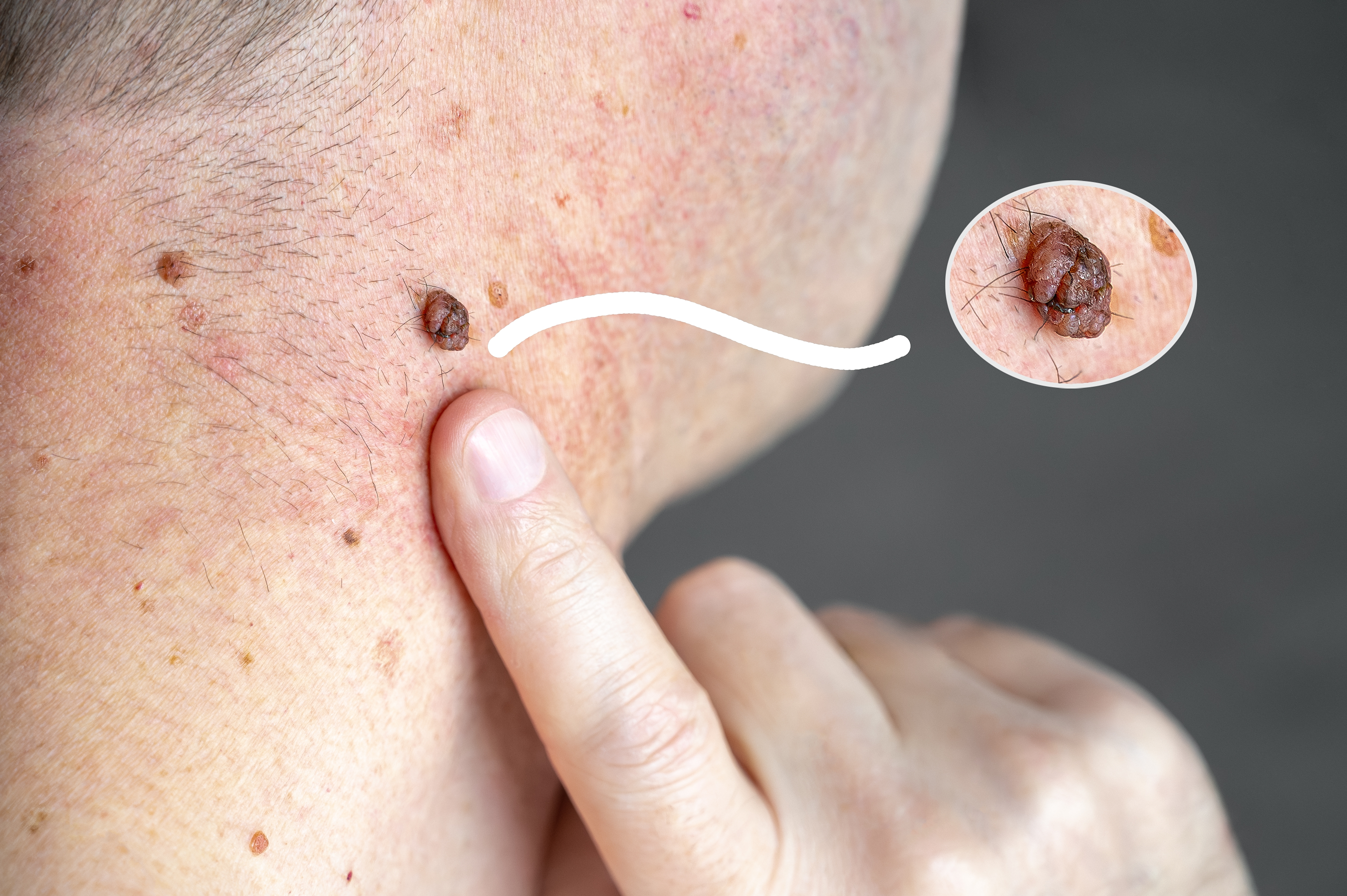
Things that usually warrant a call to your dermatologist:
- A new growth appearing after age 30, especially one that’s growing or changing
- Any mole that looks noticeably different from your other moles (the ugly duckling sign)
- A sore that doesn’t heal within 3-4 weeks
- A spot that repeatedly itches, bleeds, crusts over, or oozes
- A mole that’s changing in size, shape, color, or texture
- A dark streak appearing on a fingernail or toenail
Common benign findings that may catch your attention:
Seborrheic keratoses look like brown or black growths stuck onto the skin’s surface. They’re extremely common as you age and can look concerning because they’re often dark and crusty, but they’re harmless.
Cherry angiomas are small, bright red bumps that appear with age. They’re clusters of blood vessels and are completely benign.
Skin tags are small, pedunculated pieces of extra skin. Annoying, yes. Dangerous, no.
Understanding the Three Main Types of Skin Cancer
Basal Cell Carcinoma (BCC)
This is the most common form of skin cancer. It can appear as a shiny pink bump, a scaly pink or red patch, or a pimple that won’t go away or sore that won’t heal. BCC grows slowly and rarely spreads beyond the skin. It is the least dangerous of the three main types of skin cancer, but it still needs to be treated. Treatment is usually straightforward—often a simple in-office procedure. Prognosis is excellent when caught early.
Squamous Cell Carcinoma (SCC)
SCC often appears as a firm, red nodule or a sharply demarcated, red, scaly patch. It can develop in old scars or chronic wounds. SCC is more aggressive than BCC and has a higher risk of spreading if left untreated. Like BCC, it’s highly treatable when caught early, typically with surgical removal or other in-office procedures.
Melanoma
Melanoma is the most serious of the three main types of skin cancer. It can develop within an existing mole or appear as a new dark spot on the skin. The ABCDE signs are particularly relevant for melanoma.
Melanoma can appear anywhere—on sun-exposed skin, but also in places like the soles of your feet, within nails, or even inside your mouth.
Here’s the crucial thing: melanoma caught at its earliest stage (melanoma in situ) is highly curable and there is very little risk for recurrence or metastatic spread. This information should motivate you to pay attention, not to panic.
What Happens If You Find Something Concerning
Make the appointment. Call your dermatologist’s office and be specific about what you’re seeing. Phrases like “I have a mole that’s changed” or “I have a sore that won’t heal” signal that you need to be seen relatively soon.
Dr. Goggins and her team at Aesthetic Dermatology Associates in Media and Paoli, PA, understand that the anxiety waiting to get in for the initial appointment is real. “We make every effort to see patients with concerning skin changes promptly,” she notes.
What to expect during your skin cancer screening:
Your dermatologist will perform a full-body skin examination. They’ll use a dermatoscope—a specialized magnification tool—to examine any spots that look suspicious. This is completely painless.
If something looks concerning, the only way to know definitively what it is involves a skin biopsy.
If a Skin Biopsy Is Recommended: What You Need to Know
A skin biopsy sounds scarier than it actually is. It’s a quick in-office procedure, done under local anesthetic, where a small sample of the suspicious tissue is removed and sent to a lab for analysis.
There are different types of biopsies:
- Shave biopsy: The lesion is shaved off at the level of the surrounding skin
- Punch biopsy: A small circular tool removes a deeper core of tissue
- Excisional biopsy: The entire lesion is removed along with a margin of surrounding skin
The procedure itself takes just minutes. You’ll feel the numbing injection (a brief pinch), and then you won’t feel the actual biopsy. Most people are surprised by how quick and straightforward it is.
How long do skin biopsy results take?
Most biopsy results are received within 7-10 business days. Feeling anxious while waiting for your biopsy results is understandable. The team at Aesthetic Dermatology Associates will be in touch as soon as we receive your results and will let you know the next steps, if any are needed.
What happens after a skin biopsy?
If the biopsy shows skin cancer, your dermatologist will discuss the specific type, the appropriate treatment options, and the next steps.
The important thing to remember: most skin cancers are highly treatable, especially when caught early.
Treatment Options When It Is Skin Cancer
For basal cell carcinoma and squamous cell carcinoma, treatment often involves surgical removal of the cancerous tissue—sometimes through standard excision, sometimes through Mohs surgery that removes cancer layer by layer while preserving healthy tissue. Other options can include topical treatments, cryotherapy, electrodessication & curretage, or radiation in specific cases.
For melanoma, treatment depends on the stage. Early-stage melanoma may only require surgical excision. More advanced cases might involve additional treatments including lymph node dissection, immunotherapy, targeted therapy, chemotherapy, and/or radiation.
Dr. Goggins emphasizes the collaborative nature of treatment planning: “Every patient’s situation is different. My job is to walk through the options, explain what each involves, and help patients make informed decisions about their care.”
Follow-up care after treatment typically involves regular skin checks to monitor for recurrence or new skin cancers.
Moving From Anxiety to Action
If you’ve found something on your skin that’s worrying you, the anxiety is understandable. But here’s what matters: you noticed. You’re paying attention. And that awareness is precisely what leads to early detection and successful treatment.
Regular self-exams combined with annual professional skin cancer screenings are the most effective strategy for catching skin cancer early. Self-exams help you develop a baseline understanding of your skin so you can spot changes. Professional screenings catch things you might miss.
The best thing you can do right now isn’t to keep searching the internet. It’s to schedule an appointment if you’ve noticed something that fits the warning signs.
Dr. Goggins’ Perspective: Empowerment Through Education
Dr. Clare Goggins completed her dermatology residency at Johns Hopkins, where she was selected as chief resident—a distinction that reflects both clinical excellence and dedication to teaching. She now applies that expertise to patients of all ages at Aesthetic Dermatology Associates.
“I want my patients to feel empowered, not scared,” Dr. Goggins explains. “Learning how to examine your own skin and knowing what to look for isn’t about creating anxiety—it’s about giving you the tools to take charge of your health. When patients come in because they noticed something concerning, I’m grateful. That vigilance saves lives.”
Her advice is direct: “If you’re looking at a spot on your skin and you can’t stop thinking about it, that’s your body telling you to get it checked out. Trust that instinct. Even if it turns out to be nothing, you’ll have peace of mind. And if it is something, we’ll handle it together.”
When in Doubt, Get It Checked Out
Skin cancer is one of the most common cancers, but it’s also one of the most treatable when caught early. The combination of monthly self-exams and annual dermatologist visits creates a safety net that catches problems while they’re still manageable.
If you’ve noticed a suspicious spot, if you have a mole that’s changed, if you have a sore that won’t heal—don’t wait. Aesthetic Dermatology Associates serves patients in Media and Paoli, PA, and Dr. Goggins sees both adult and pediatric patients.
The appointment you’re nervous about making? That’s the one that might save your life.
You’re not overreacting. You’re not wasting anyone’s time. You’re doing exactly what you should be doing: taking your health seriously.
Ready to schedule a skin cancer screening or discuss a concerning spot?
Dr. Goggins and her team are here to provide expert evaluation, clear answers, and compassionate care. Because when it comes to skin cancer, early detection isn’t just important—it’s everything.
Related links
See Dr. Goggins’ provider’s page on our website: https://adaderm.com/providers/clare-goggins-md/
Review 5-star rating given by patients on Zocdoc: https://www.zocdoc.com/doctor/clare-goggins-md-504595
Visit Our Locations
Media, PA
| Mon: | 7:30 am - 5:30 pm |
| Tue: | 8:00 am - 4:00 pm |
| Wed: | 7:30 am - 4:00 pm |
| Thu: | 7:30 am - 4:00 pm |
| Fri: | 7:30 am - 1:00 pm |
Paoli, PA
| Mon: | 8:00 AM - 4:30 PM |
| Tue: | 8:00 AM - 4:00 PM |
| Wed: | 8:00 AM - 5:30 PM |
| Thu: | 8:00 AM - 4:30 PM |
| Fri: | 8:00 AM - 5:00 PM |
Stay Informed with our Newsletter

Book Your Appointment Today!
Choose the option that works best for you:
Prefer to speak with someone? Call or text us:

Media, PA Office - Call or Text (610) 566-7300
Paoli, PA Office - Call or Text (610) 647-4161
Want to book online now? Select a provider below:
Note: Self-scheduling is currently available for Dr. Ko & Bridget Lolli. For all other providers, please call or text the office.