
Temple Fillers
Restoring What the Temples Lose First
Many patients notice the temples thinning years before anything else on the face changes, since this is often one of the earliest places facial volume disappears. A hollow temple can pull the eyebrow down, sharpen the bony ridge above the eye, and change the entire upper face. At Aesthetic Dermatology Associates, board-certified dermatologists rebuild that lost cushion with filler suited to one of the more delicate regions we treat.

What Temple Hollowing Looks Like, and Why It Happens
The temple holds a small fat pad that sits directly over bone, just beside the eye socket. That pad starts shrinking earlier than most people expect, sometimes by the late twenties, and the change shows up as a visible dip just past the outer corner of the eyebrow.
Once that cushion thins, the bone underneath becomes more prominent, and the eyebrow can lose some of its lateral support and drop slightly. Glasses that used to fit start sliding, since the temple no longer holds them the way it once did. None of this happens because of anything you did; it’s how that particular fat compartment ages.
Patients often describe the change as their face looking sunken or skeletal at the sides, even when the rest of the face looks unchanged. Restoring temple volume softens that contrast and brings the upper face back into proportion with the rest.
Why Choose a Dermatologist for Temple Fillers?
The temple is one of the more demanding areas to treat safely. It sits close to the superficial temporal artery and its branches, and small connections exist between vessels here and the blood supply of the eye itself. An injector without a precise understanding of this anatomy carries real risk, including, in rare cases, vision changes.
The frontal branch of the facial nerve also runs through this region, close to the surface in some patients. Injecting at the wrong depth can affect the muscles that raise the eyebrow, a rare effect but not one worth risking with an inexperienced provider.
At Aesthetic Dermatology Associates, a board-certified dermatologist performs or directly supervises every temple filler treatment, using techniques built around these specific risks rather than a generic injection pattern.
What Is Temple Filler, and How Is It Placed?
Temple filler is typically a hyaluronic acid gel chosen for moderate firmness: structural enough to rebuild lost volume, soft enough to sit comfortably against bone in a thin-skinned area. We often use a blunt-tipped cannula here rather than a needle, entering through a single point and threading the product along a safe plane above the muscle and below the more vulnerable structures.
The goal is a flat or slightly convex contour from the brow to the hairline, not added bulk. Overcorrection here looks unnatural quickly, so we build gradually and reassess as we go.
What Temple Fillers Can Address
Temporal Hollowing
The most common reason patients seek this treatment: a visible dip at the temple that makes the face look gaunt or tired, often noticed first in photos taken from the side or in bright overhead light.
Brow Support
Because the temple sits just beside the tail of the eyebrow, restoring volume here can lift sagging brow tissue slightly and soften the hooded look some patients develop as the temple flattens.
Facial Balance After Cheek or Under-Eye Treatment
Patients who’ve already had volume restored in the cheeks or under the eyes sometimes notice the temple looking comparatively hollow once the rest of the face fills back in. Treating the temple completes that correction rather than leaving one area behind.
Your Temple Filler Appointment
We examine your temple contour from multiple angles, including a side and overhead view, since hollowing here is often easier to see from above than straight on. We’ll also ask about your eyebrow position and any past brow lift or Botox in the area, since both affect how we plan treatment.
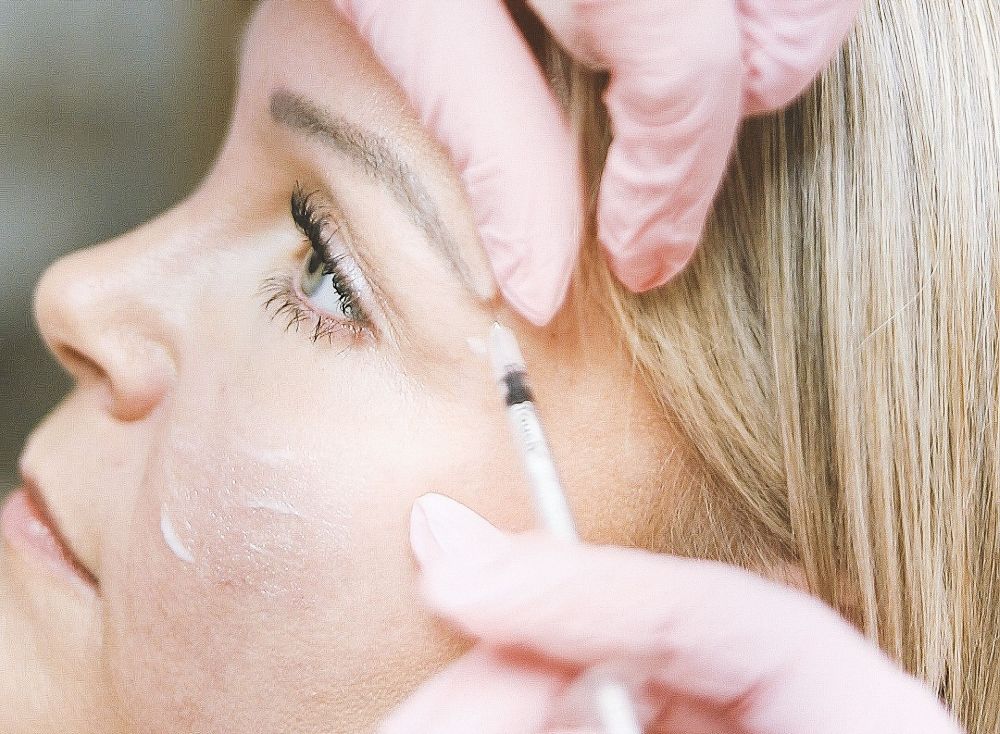
After topical numbing, we inject through a small number of entry points using a cannula technique, threading filler along the safe plane identified during your consultation. The treatment generally takes 15 to 20 minutes per side.
Swelling is usually mild, though some patients notice tenderness when chewing or opening the mouth wide for a day or two, since the temporalis muscle sits just beneath the treated area. Bruising is possible but typically minor.
We schedule a follow-up around two weeks out to check symmetry and confirm the brow and temple read correctly together.
How Long Temple Filler Lasts
Temple filler lasts 12 to 18 months on average. The area moves relatively little compared with the mouth or cheek, which helps results hold.
Patients who’ve lost significant volume sometimes need a second session a few months after the first to build to a full result gradually, rather than correcting everything in one visit.
Temple Filler Pricing at Aesthetic Dermatology
Temple filler is priced per syringe, and most patients need one syringe split between both temples for a noticeable result. More significant hollowing may call for additional product.
We’ll discuss a personalized estimate at your consultation, and we periodically offer promotions on temple filler alongside our other facial filler treatments.
Frequently Asked Questions About Temple Fillers
Is temple filler risky?
Like any filler treatment near the eye and major vessels, it carries more risk than filler placed in less sensitive areas, which is exactly why we treat it with extra caution. At Aesthetic Dermatology Associates, every treatment stays under board-certified dermatologist oversight, using a cannula technique designed to reduce that risk.
Will temple filler lift my eyebrows?
It can offer a subtle lift to the tail of the brow by restoring the tissue support beneath it, though it isn’t a substitute for a surgical brow lift if sagging is significant. We’ll discuss what’s realistic for your face during your consultation.
Why are my temples hollow if I’m not “old”?
Temporal fat loss often starts earlier than most other facial aging, sometimes in the late twenties or early thirties. It has more to do with how that specific fat compartment behaves than with overall age.
Does temple filler hurt?
Most patients describe mild pressure rather than sharp pain, especially with topical numbing and a cannula technique that limits the number of needle entries.
How does temple filler relate to other facial filler treatments?
Temple volume connects visually to the brow, cheek, and overall upper-face contour, so we often discuss it alongside cheek filler during a comprehensive consultation, particularly for patients noticing several areas of volume loss at once.
Schedule Your Temple Filler Consultation
The temple rewards a careful, conservative hand more than almost any other area we treat. At Aesthetic Dermatology Associates, that’s exactly the approach board-certified dermatologists bring to it.
Noticing hollowness at your temples? Reach out to schedule a consultation.
Important note
We look forward to hosting you for your appointment. Please note that we adhere to a strict 24-hour cancellation policy. If your appointment is not cancelled at least 24 hours in advance, or if you are considered a “no show,” a standard $75.00 fee will apply.
All appointments require a credit card authorization at the time of booking. Failure to cancel within the specified timeframe may result in $75.00 being charged to the card on file.
Thank you for your understanding and consideration regarding this policy.
Related Services
Visit Our Locations
Media, PA
Media, PA 19063
Phone hours may differ.
| Mon: | 7:30 am - 5:30 pm |
| Tue: | 7:30 am - 4:30 pm |
| Wed: | 7:30 am - 4:30 pm |
| Thu: | 7:30 am - 4:30 pm |
| Fri: | 7:30 am - 4:30 pm |
Paoli, PA
Paoli, PA 19301
Phone hours may differ.
| Mon: | 7:30 AM - 4:30 PM |
| Tue: | 7:30 AM - 4:00 PM |
| Wed: | 7:30 AM - 3:45 PM |
| Thu: | 7:30 AM - 4:30 PM |
| Fri: | 7:30 AM - 3:30 PM |
Stay Informed with our Newsletter

Book Your Appointment Today!
Choose the option that works best for you:
Prefer to speak with someone? Call or text us:

Media, PA Office - Call or Text (610) 566-7300
Paoli, PA Office - Call or Text (610) 566-7300
Want to book online now? Select a provider below:
Note: Self-scheduling is currently available for Dr. Goggins & Dr. Waller. For all other providers, please call or text the office.